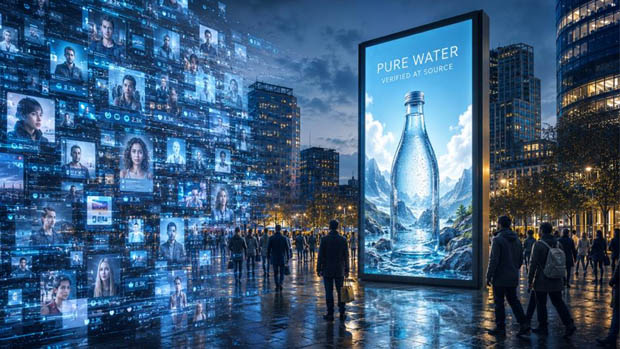
As synthetic signals multiply, the value of accountable public presence rises. Original editorial illustration: Sea Change Project.
At the WOO Annual Congress in London, I kept hearing the same concern across presentations and panels: trust. It surfaced through measurement, AI, standards, sustainability, and the relationship between media and the public. The language changed; the concern did not.
I heard it again at the Association of Advertising & Marketing Singapore conference. Soon afterward, I asked in my ALOOH keynote in Costa Rica: could OOH use AI without eroding the medium’s credibility?
Three gatherings do not constitute a global study, but they provide a useful signal. Industry leaders are approaching the same problem from different markets.
By synthetic abundance, I mean more than AI-generated ads. It includes synthetic identities, audiences, interactions, and performance signals—outputs that can be produced at scale and made to look human. Some are legitimate simulations; others resemble engagement without representing it. Programmatic markets know the adjacent problem: bots and invalid traffic can distort impressions and audience data.8
Trust is becoming infrastructure. People need it to accept what they see. Buyers need it to judge inventory and measurement. Regulators look for evidence that industry controls work.
OOH enters this period with an unusual advantage. It operates in public. A billboard or transit display has a fixed location and an accountable owner. Its relationship to the surrounding community is visible. Brands appearing there can seem more established than brands encountered in anonymous or low-quality digital placements.
OUTFRONT Media CEO Nick Brien makes the human case directly: “I believe in-real-life interactions are more essential than ever to building consumer trust and creating human engagement.”5 It is an executive judgment, not independent proof. Two studies offer qualified support. Future Foundation research reported OOH as the second-most-trusted advertising medium after television.1 A later Harris Poll found stronger favorability toward DOOH than toward several other formats.2 The first study is dated and industry-commissioned; the second measured favorability rather than trust.
The defensible conclusion is useful: public physical presence can provide a credibility signal under certain conditions.
Exhibit 5 — The Attention-Trust Tension
Attention is an input. Sustainable value depends on the context in which it is earned and the credibility it preserves.
Tactic
interruption
Context
fit
Credibility
belief
Outcome
response
Erosion
avoidance
Productive path
Extractive path
ATTENTION ≠ OUTCOME
Evidence base: attention and trust literature; causal sequence is an SCI interpretive model.
Attention earns value through context and credibility; attention alone is not an outcome.
Trust belongs to the whole system
A consumer may trust the setting and reject the advertisement. A buyer may trust the media owner while questioning the attribution model. A community may welcome useful information but object to intrusive data practices.
Trust attaches to more than the screen - it extends to the creative and the brand making the claim, and to the process used to place and measure the message.
The same capabilities can import some of digital advertising’s least welcome habits. Synthetic engagement may look like demand. Automated reporting can distance a metric from the human activity it claims to represent. Responsibility may disappear into the workflow.
The practical lesson: every additional capability needs a visible owner.
If AI adapts creative, someone should be able to explain which source material was approved and how the output was reviewed. If an automated system changes campaign parameters, its authority and stop conditions should be known. When measurement links exposure to an outcome, the method should state what was observed, what was inferred, and where uncertainty remains.
OAAA President and CEO Anna Bager drew the boundary plainly: “We can’t lose sight of our human superpowers or ethics, as AI becomes increasingly prevalent.”6 NIST’s Generative AI Profile treats information integrity, provenance, testing, and incident disclosure as risk-management concerns.3 The OECD AI Principles likewise emphasize transparency and accountability.4
OOH doesn’t inherit trust permanently - each new capability has to earn it.
Public presence creates an obligation
OOH’s physical character is sometimes discussed as if trust comes with the location. It doesn’t. Public presence offers the opportunity to earn trust, but it also puts poor judgment on display.
A roadside message has to respect the short interval available to understand it, and transit and retail displays share space with people trying to accomplish something - which makes context part of the product.
The distinction matters more as competition for attention intensifies. Disruptive or repeatedly delivered creative may produce immediate notice. It can also diminish acceptance over time. The goal should be valuable attention within a credible setting, not the largest possible attention score detached from the experience that produced it.
Data use requires the same restraint. Relevance should deliver a recognizable benefit. The method should be proportionate to that benefit, and creative provenance should be knowable. Public environments are shared spaces before they are media inventory.
OOH has spent years building flexible infrastructure around physical assets. The next phase will connect them to AI-supported decisions and commerce signals. Measurement ambitions will rise too. Technical capability will spread. Trust may prove harder to copy.
That makes stewardship a competitive issue. Media owners can reduce verification costs by publishing credible methods, protecting creative quality, and correcting claims when the evidence changes.
No company can declare itself trusted. The market grants that status after repeated evidence of competent conduct. OOH has a valuable starting position because it is visible and physically accountable. Keeping that position will require discipline as the system becomes more automated.
Why industry gatherings matter
This is one reason participation in WOO events matters so much. Not only because WOO, as the “Association of Associations” gathers so many national associations, but also because the WOO Global Congress lets people compare the questions being asked in different markets and hear where the answers diverge. Patterns become visible before they are formalized into standards or research programs.
The value depends on active participation. Operators bring market realities that a global framework might miss. Buyers expose cross-border friction. Technology companies can explain what new systems make possible and hear where stronger controls are required.
Tom Goddard, WOO’s President, connects contribution to credibility: “Every market that contributes, whatever its size, strengthens that collective credibility.”7 If we want a voice in the standards that will govern the next market, we have to be in the room while they are being formed.
Trust is scarce infrastructure because every other layer depends on it. Without trust, intelligence becomes suspect and measurement becomes negotiable. Public presence then loses part of its value.
Sources
Questions for Leadership
Which current practices involving data or automation—and which creative choices—could weaken the trust associated with your physical presence?
Can your organization identify who owns each consequential automated decision?
Do your measurement partners distinguish observation from inference and disclose uncertainty clearly?
What would your company stop doing—even if it improved a short-term metric—to protect credibility?
Which trust safeguards would create more value if the industry built them together?